 I'm sitting in an internet cafe in Patan, Kathmandu, exhausted after spending the whole afternoon in Bal Vinod, a government school just round the corner from here. My name is James Lewis and I am one of two tour managers of BackPact, a theatre-education initiative run by students from the University of Cambridge. Today was our last day working in Nepal. We have been here for about 10 days. During that time we have twice visited Bal Bygan and Bal Vinod, two of the schools supported by Nepal School's Aid. We have been moving around North India and Nepal since July and have experienced a whole range of different educational environments. I think I speak for everybody in the team when I say that these two schools have been among the best we have visited. On the whole, the children we have worked with have been bright, enthusiastic and creative. We have also been delighted to encounter teachers eager to participate in and learn about the activities we have presented. Bashu, a NSA funded teacher at Bal Bigyan, was especially keen, and attended three of our four sessions. I am working on a resume of all the work we did with the children which I will send him in the next couple of weeks. Hopefully he will be able to continue to use some of the methods and activities that we have been experimenting with over the last few days.
So what exactly do we do? In the NSA schools, our workshops have run from 1.15 in the afternoon to about 5pm in the evening. The workshop starts with a 20 minute play performed by all members of the group. Our play is a simple story about a Prince who is abducted by a wicked music-hating witch. His princess, in a reversal of the fairy tale stereotype, sets off on a journey to save him. After some hiccups, she eventually achieves her goal, kills the witch (with a song) and returns home with the (traumatised) prince to live happily ever after. It is a light-hearted piece and it is patched together with various different theatrical techniques (song, tableau, sound-scape, rap, slap-stick, mime). In short, the rest of the afternoon is devoted to exploring these techniques.
We start with a few simple call and response games, which get gradually harder as the calls start to contradict the expected response. So if the caller shouts 'Walk!', the rest are expected to run. If the caller shouts 'Stop!', the rest are expected to go. You can imagine the confusions. Eventually, the caller is not one of us but a student, we step out and the game progresses independently. After this, we divide into four groups. Two of us taking approximately 20 children and we introduce increasingly more difficult activities and games. Often, the odd song gets exchanged one way or the other. After a mid afternoon cup of tea, the workshop becomes almost entirely led by the children, as we introduce tasks that encourage their own ideas. If there is time, the students perform some of what they have learnt to each other.
A highlight for us was this afternoon when a mini-performance was arranged for us at Bal Vinod. Two students from year 10 performed a short drama about a disagreement between a father and son. They had written the piece themselves, it was tense and dramatic and we enjoyed it very much. After that we were treated to a Nepali song, some impressive dance moves from a couple of younger students and some music-hall style physical comedy from the very talented school caretaker. A great moment to cap off what has been a fantastic few days. Thanks very much to both schools and everybody at NSA for facilitating this, it has been a great pleasure.


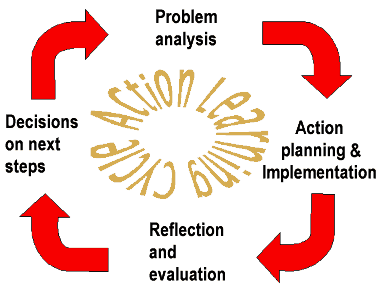 The headline is a virtual motto for the technique of action learning, commonly applied to develop management skills in semi-experienced individuals. The basis of the technique is that individuals work on a project then meet regularly to share progress and learning, but also to subject themselves to intense questioning. There are often casualties too!