Wednesday, 22 December 2010

English Language: News from Kathmandu #6

"Reporting on the head teacher's workshop that just finished earlier today. We thought the workshop went really well. The head teachers and teachers worked really well together, as did the schools. We asked schools to work
together for the first group work session to discuss ideas for school improvement. The second session was done in two big groups – one of head teachers and one of teachers. Both groups brainstormed the qualities of a good headteacher – the results were quite interesting! It seemed like the teachers really enjoyed making their list, they
even used a mind map! The reactions of the head teachers were very positive and appreciative. The feedback from both groups about this activity was positive and goodhearted.

The school improvement plans were quite impressive. Each group filled up an entire A3 sheet, or two! They mentioned many ideas that we had already thought of, but also brought up some very innovative suggestions.

In the afternoon, the school groups got back together and brainstormed about "Problems and Priorities" regarding their move to English Medium. We all realize this is going to be a slow and steady process. This filled up another A3 sheet, and the headteachers took all of their sheets back with them, with assigned homework: they have to make a mindmap which shows school improvement in combination with a plan for moving into English Medium (a long term plan). We felt that everybody worked hard and were focused during all group work activities.

After our experience today, we feel that Janak and Anil would make excellent tutors. We learned that there was actually a lot going on already in terms of school improvement – some of our ideas are already  up and happening at Lalit Kalyan and Himalaya.

To finish off the afternoon, we showed a few activities that could be used in English workshops of their own . These were well received and at times produced very funny and entertaining results. Our favourite was Janak's dramatic reenactment of a scene from the famous Nepali poem, Muna Madan! We were so pleased that we managed to get all the participants to act! It was great to see everyone break away from the grammatical analytical learning that they are accustomed to. We see that there is definitely a possibility for change in both learning and teaching practices in Nepal.

We were presented with a token of love from Chiri Babu and Parsuram from Bal Bigyan. We were touched! Earlier in the week, we received a  token of love from Ramesh at Lalit Kalyan. We will treasure these gifts as a reminder of the great time we had in Kathmandu!

Tomorrow we are going to visit one last school, Sree Sramik and then we're off! We feel we have put an enormous amount of energy into these two weeks – more than we thought we would! However, we really enjoyed
working with these teachers and headteachers. We feel we have made a positive impact here in Patan. Thank you for those who commented on the blog so far – it's nice to know there is interest in what we've been doing."
Namaste.

M&M (two tired smarties :) )

Sunday, 19 December 2010

English Language: News from Kathmandu #5

Today the focus of our process changed. Previous days had been based in-school and used observation and demonstration as the vehicle for development, but today it was time for a teacher training workshop. Based at the Greenwich Hotel in Patan M&M put the Heads and teachers from Bal Vinod and Bal Bigyan schools through their paces. A very important lesson here for our volunteers of 2011: Run part of the session as if in-school with the teachers as pupils!

"Overall, we felt the workshop was a success.  We thought the teachers picked up a lot of useful tips and new activities that they can use in their own classrooms.  The practical component worked really well - we used the teachers as pupils, thereby letting them experience this "new" method of language teaching from the pupil's point of view.  We made an effort to explain how each activity worked: which learner type was targeted, how the activity could be used at different levels, and speaking/reading/writing/listening were also highlighted in the course of each activity.  All the activities were theme based around a unit concerning Sports.  We wanted to show how they could transition from their current grammar-based system to a theme-based approach to language teaching.  The practical section was very well received and we could see some light bulbs going off.

As foreseen, there was indeed a bit of language barrier between us and the teachers who attended the workshop today. This was more apparent in the morning, when we were focusing on the theory behind different learning types and styles. We are wondering if this is a result of different pronunciations (us versus Nepali pronunciation) or whether it is actual language. Some basic culture differences emerged during the course of the workshop as well.  We found many similarities between the pupils we had observed in the schools, and the teachers who came to the workshop.  It is apparent that they are accustomed and trained to copy - they were constantly picking up their pens to write something down, even when it wasn't part of the activity!  They were hesitant to challenge or question concepts or information we were presenting (again, this may be a language issue).   It's apparent that the role of the teacher is respected - which is great on one hand, but on the other hand, it made the feedback forms we received at the end of the workshop not very useful. The feedback forms simply repeated the questions back to us, with some affirmative answers.  During the course of some of the auditory activities, it was clear the teachers were not listening to each other.  We saw this in the schools, where pupils were talking or writing while other members of the class were answering the teacher's questions.  After this workshop, we realize that the  most important thing to concentrate on in the future of this project is language training for the teachers. As the teachers learn more English, they can transfer that knowledge to the pupils.  This will take some time.

We are altering a few things for tomorrow's workshop, as some of the school participating have very little knowledge of English.  Wish us luck!"

Until then,
M&M

The Kathmandu Post-"Moral education in middle schools"

Would you believe it, the article below has just appeared in today's Kathmandu post and at least tells us we are on the right lines with our plans for this next year, including the teaching of P4C techniques. On the one hand it's gratifying, but on the other hand we can't help but feel like we have been visionary and right all along!

KATHMANDU, DEC 18 -
Concluding that the new breed of students are exhibiting an ever diminishing level of morality in the absence of moral teaching, the Curriculum Development Centre (CDC) is endorsing moral education as a separate and compulsory subject in the school-level curriculum.

The reform comes almost one-and-a-half decades after the government dropped the “Naitik Sikshya” [moral education] course from its old curriculum. The CDC believes the course will infuse students with morality. The syllabus that has been approved by the Ministry of Education will get an entry as a compulsory course —Moral Education—in grades six to eight. The course will have 50 marks in the annual examination. Chitra Prasad Devkota, Director General of the CDC, said, “If the work goes as planned, the course will be incorporated in the curriculum from the upcoming session.” The textbook will give students a ready set of values, rights and wrongs that helps them to fortify their faculty of judgment in the long run.

The CDC took the step as teachers and intellectuals suggested the necessity of moral education to reverse the dropping standards of morality in students.

Education experts hold exposure of children to violent films and decade-long conflict in the country responsible for the violent activities today’s kids have internalised. “Moral lessons in schools can play a crucial role in mitigating such types of problem,” Bidhya Nath Koirala, an education expert, said. “It will help develop a sense of rights, duty, honour, non violence and humanity.” According to Devkota, the book will deal mainly with six topics. It will include the norms and values the world has adopted as well as individuals’ responsibility and duty. The book will also comprise lessons on peace, truth, good behaviour and non-violence.

“The moral education imparted during the Panchayat era intended to promote the partyless regime and religion,” said Devkota. “But, the new syllabus will teach students self-discipline.”
Click HERE for the actual article

Posted on: 2010-12-19 09:18

Saturday, 18 December 2010

English Language: News from Kathmandu 4

Here we go, the comments are getting funnier!


Greetings!
I taught my second lesson this morning at Lalit Kalyan. This was a grade 4 class that we had observed doing a lesson with storytelling two days previous. I wanted to also do a lesson that involved storytelling and showing different methods of helping students to recall and retell a story. I did, however, underestimate the English level of the students! Perhaps because both lessons we delivered yesterday were so well received, we were left with the impression that we were underestimating the ability level of the students – so we planned this lesson to be a little bit more complex. Halfway through the lesson, I realized the students' ability was not high enough to comprehend the full content of the lesson we had planned.
The lesson progressed in stages, from me telling the story with pictures, to reviewing the story with the pictures on the wall, to the students putting the pictures in the correct order. We then moved to trying to sequence the bits of dialogue from the story in order as well. After some repetition of the instructions in Nepali from the teachers who were present, the students caught on fast enough and understood the dialogue. The next stage of retelling and recalling was where the lesson plan got too complex. It was clear to me as I was teaching, and if it had been my regular class, I would have known when I was pushing them, and when I was losing them. I think it was good, however, for the teachers to see the gradual sequence of activities, and how it might progress to more complex tasks – all of them, however, still based around a very simple story! In any case, not every lesson goes over perfectly, and as teachers, we are all too familiar with how seemingly random this can be. We might teach the exact same lesson to two different classes and get two completely different responses. In any case, the students did learn some new words, learned a new story, and were eager to learn more. I am constantly impressed by how attentive and adaptable the students here are.
In the afternoon, we visited a school we had not yet been to. As we were driving there, we crossed the river for the first time. A cow was grazing on garbage along the riverbank. Plastic bags, orange peels, rubble, dead birds, everything was everywhere. I started to think that the garbage truck we had seen around town simply came to the river and dumped everything there. There were definitely no tourists in this part of town. If you didn't know where the school was, you would walk right past it. Amidst a bunch of ramshackle houses (I'm guessing they were once temporarily houses), there is a very narrow three story concrete building that houses the school. I have never seen classrooms so small! Martine already mentioned the grade 1 class we observed, but we also went downstairs to observe a grade 5 class.
The grade 5 class took place in the narrowest classroom I have ever seen. There was an aisle down the left hand wall, barely wide enough for one body, and 5 rows of long benches and desks down the right side of the room. For purely logistical reasons, many of our teaching techniques and ideas would be simply impossible to do in a setting like this. The class was working from a textbook on a chapter called “Famous People”. The teacher read the text out loud in English, sentence by sentence, pausing after each sentence and explaining it in Nepali. The text was about Elizabeth I, William Shakespeare, Charles Dickens and Sir Walter Raleigh. I turned around and looked at the tin roofs held down by old rubber tires. I couldn't help but think, who cares about Hamlet when there is nothing to eat? Is Queen Elizabeth really relevant when you are sleeping next to a pig pen inside your house?
I am certain that it is just as easy to teach the simple past tense with Nepali heroes and celebrities, as it is with 16th century English monarchs. The students would gain so much more from their language learning if it applied to their daily lives and fuelled their imaginations about their own country and heritage. I truly felt like I had stepped back in time to colonial days – and yet Nepal has remained fiercely independent. This is visible everywhere, except in the educational resources – why?
We are looking forward to a productive day tomorrow, perfecting the workshop content for Sunday's presentation. I wish we had more opportunity to spend time in the schools; alas, exams are ongoing and then holidays begin.
Until Sunday!
Monika
                                -------------------------------------------------------------------------
Namaste,

Today was quite a different day from the others as we went to visit Bal Kalyan school in the afternoon.
It is situated much further north about ½ hour's drive in the taxi. As the journey progressed, my mood changed. The area we drove through was very poor and all along the river rubbish was dumped in great big piles, animal carcasses amongst the rubble,...almost a typical Nepal scene, but several degrees higher.
We walked the last leg through a narrow street where children played in the dirt with their ever present smile.
The teachers were very welcoming and we observed a Grade 1 class: they were learning the vowels of the English alphabet. The teacher showed them the letters on bits of paper and the children pronounced them individually. She was very lovely with these deprived kids. The first teacher this week I noticed actually smiling at the children, encouraging their learning and praising them!!They all looked really happy to be there and to be learning.
However she kept up the same pattern for a bit too long I found. Reading a simple story to the children and letting them find vowels in a different context would have kept their attention a bit longer.
I taught them a short lesson, new words to do with sporting activities. I used a lot of actions to go with the pronunciation to help them remember the words later. They loved that and theyalmost got overexcited, but I managed to calm them down with another activity.
We did a couple of team games and that went down well! I was amazed at how quickly they picked up and adopted these activities. Their hands shot up to have a go and they didn't shy away from repeating the words individually.
Afterwards in the staffroom the feedback was limited due to the fact that the teachers don't speak much English. And why should they I wondered. Here they are doing a brilliant job teaching children who have less than nothing, who would play in the dirt if they didn't come to school, and they manage to give them some sort of education! The children come to school...what an achievement and hat off to those teachers. The rooms in which they have to deliver the lessons are very small...one can hardly move in them. I left with a feeling I can't quite describe...and also with the thought that we can't approach this school the same way we are approaching the others.

More tomorrow,
Martine

Thursday, 16 December 2010

English Language: News from Kathmandu #3

More news from Martine and Monika:

"Hello everyone! Yesterday we spent most of the afternoon on a rooftop cafe preparing lessons for today: our first day of teaching. Monika taught at Bal Vinod and I delivered a lesson at Bal Bigyan.
It was a great experience and I thoroughly enjoyed it. The children had come in specially to be taught by us. Something that would never happen in England! There were 24 pupils and they couldn't wait to enter the classroom whilst I was preparing it.
Once we started I could not quite believe how adaptable the pupils were. They are so used to shouting out answers ad hoc and repeating after the teacher in a very haphazard way, but after a few times of me demonstrating how I preferred them to answer in unison, they very quickly adapted their behaviour. Their enthusiasm was amazing and they loved the action based teaching. The boys in particular were participating well and very excited to win the competitions.
One thing that really amused me was the fact that the pupils stand up to answer a question and don't sit down unless told to do so. At times I noticed pupils just standing behind their desksa and wondered why...they were just waiting for me to say they could sit down again.
It is fantastic to teach such keen pupils. Their English comprehension is very good. All credit to the teachers. The pupils are also happy in the school, they want to be there and that is lovely to see.
At the end of the lesson I was almost mobbed and showered with questions, in particular “Do you like Nepal?” They are very proud of their country and want us to like it as well. They also asked for my autograph before they left and for a moment I almost felt like a famous star!
I will always remember this lesson, especially the smiles and above all the keenness of the boys!
Tea and biscuits were duly served and lots of teachers joined us in the classroom to chat about the lesson.
I am looking forward to the lesson at the school we were unable to reach yesterday.
Until then.
Martine

                                      ------------------------------------------------------------------------

So today was our first teaching day at the schools here.  I taught in the morning at Bal Vinod.  It was the same class we observed two days ago, and I decided to make this class a follow-up to what they had learned on Tuesday.  Before class began, two girls came into the room and were surprised to see me there, setting up.  I asked them if they wanted to help and they assisted me in posting vocabulary words on the walls of the room.  All the students stand up when the teacher enters the room, and they wait for you to give them permission to sit down.  On the one hand, such formalities are nice, and on the other hand - so unfamiliar! The lesson continued on the theme of "introductions", giving students the vocabulary and the sentence structure to be able to introduce themselves as well as other people.  I tried to make the class as interactive as possible - mixing in strategies for visual, kinesthetic and auditory learners.  The students seemed to enjoy the class, and I received positive feedback from the teachers as well as the headteacher who observed the class.  After both Martine's class and my class, someone would always approach me and comment about how good it was, and at the same time, how they see how much planning it takes!! This is very true - to make lessons work for all the different learning types, and also to incorporate all the language skills in each lesson DOES take a tremendous amount of planning.  The smiles on the students' faces, and their improved pronunciation is a great pay-off though!

Both Martine and I were impressed with how quickly the students caught on to our requests.  We taught them to raise their hands instead of shouting out, and within 2 tries, everyone seemed to get it.  We could not, however, stop them from jumping to their feet when they were called upon.  And of course, as Martine mentioned, we would forget to ask them to sit, and 2 minutes later, might find them still standing, rooted to their spot! It's a joy to teach such eager learners.  I still can't believe they voluntarily came to school on their day off - nowhere in North America would that happen!  I could see that the boys especially were happy to be up and out of their seats for some of the activities, and the girls took the speed/competition exercises very seriously.  Overall, I think the methods and exercises we tried out today were successful.  There will be an adjustment period, but the students adapt far more quickly than we would have imagined.  I look forward to tomorrow's lesson.  Each class is always different, and it will be another great experiment to see how these students take to our ideas.

Wishing you a pleasant evening, or day, or whatever time zone you're in - enjoy!"

Monika
  

Wednesday, 15 December 2010

English Language: News from Kathmandu #2

Another post from Martine and Monika in Kathmandu.


"Today we observed another class in Lalit Kalyan, and again we were welcomed in the usual friendly Nepali way with tea and biscuits and plenty of smiles.

The teacher had written the objectives on the blackboard and topic, so it looked promising.
She also had written words and sentences on paper for the pupils to read while she was telling a story. Unfortunately I could not understand the story, as she told it very quickly. She made the pupils repeat words over and over again and made them spell the words individually. It was hard to give feedback as the Head told us she was a very good teacher, who had taught at the school for quite some time. The teacher herself asked us for feedback immediately after the lesson (in front of the children) and we told her how enthusiastic the children were and how impressed we were with the resources she was using...
I was mobbed by the children after the lesson! They are very excited.
We are very much aware of how different both teachers and pupils are re learning. We have spent all morning on a rooftop reviewing the workshop for the teachers. we have kept most of my  original plan, but altered a few approaches as now we have a better idea of how they work and how their English is. We want it to go really well with plenty of practical stuff.
We can not observe this afternoon as we can't reach the school due to demonstrations all over Kathmandu, Patan and Bhaktapur. The government has put up oil prices and people are very angry...
The only big down side here is the pollution. I had to buy a mask to protect me a bit from all those toxic fumes.My lungs are used to the healthy mountain air...Hopefully we can escape to the country side again on our free day?
We have taken loads of pictures and will try to send some, but the internet connection in the cybercafe is VERY slow. It takes me around 20 minutes before I can even read my mail!
But no complaints. 
One thing I had forgotten since my last visit was how Nepali people don't like to say 'no'. So when we went walking the other day a conversation would go like this:
"To the temple, 15 minutes?" Reply: "yes"
"Or 30 minutes?" Reply: "yes" 
"Or 1 hour?" reply: "may be"
A supposedly 1 1/2 hour walk took us about 4 hours, but who cares in such a friendly place?"
More soon
Martine
                             ---------------------------------------------------------------------------------------


"We saw one more lesson this morning (unfortunately the afternoon was canceled due to a political protest caused by rising oil prices).  This lesson used more resources than the others we have seen so far.  It was a Grade 4 class with approximately 15 students present.  The class started off with a quiet meditation/blessing which the students took very seriously.  The objective was clear on the board, though both Martine and I were confused by the end of the lesson.  It was not clear that the objective had been met, nor were the students made aware of the objective.  I think just a little bit more lesson plan structure would be a simple and highly productive addition - by using a starter (or introductory activity) and a short plenary (or quick review) at the end of the lesson, students would find their language learning more grounded, and not just random words floating through their minds for 40 minutes.
The teacher made quite an effort using visuals to tell a story to the students.  Once the story was finished, students were asked to pronounce and spell out vocabulary words from the story. This went on for quite some time.  Students are asked to rise from their seats, and once they are standing, they say the word, spell it, and then say the word again, spelling bee style.  Later, the students were asked to come to the front of the room and do a similar activity.  This time the whole class repeated back what the student at the front had said.  This caused some rather erroneous pronunciation of many of the words.
After observing three classes, there are some recurring elements coming up.  Drills are popular - asking the students to repeat words over and over again, or spell them over and over again.  Individual work is most common - we have not seen any group work and just a small element of partner work.  What perhaps is most different from the way we teach languages  in the UK (and Canada) is the lack of context in the learning here.  Each lessons seems separate from the rest.  I'm not sure if this is a factor of us arriving during exam time, and thus seeing "unreal" lessons in an isolated fashion, but even the way the textbook is structured, there is no overarching theme that the students can hold onto.  They move from grammar to spelling to another grammar point, perhaps to a small game, and then a written drill.  The topics and the vocabulary do not hang together as a coherent whole.
We are a bit hesitant offering negative feedback or "constructive criticism" at this stage.  After all, what is being done is not "wrong" per se, it is just a different style of teaching.  We hope that by attending the workshop, the teachers will be able to gather some fresh ideas and methods that they can apply in their classrooms.  Changing from the "old fashioned" system to what he have now in the UK (and North America) was a gradual change that took over 50 years, so we certainly can't expect overnight results here!  I feel that more resources would certainly be helpful - flashcards, vocabulary packs, laminated short story boards, etc.  But at the same time, through the workshop, Martine and I hope we have can show the teachers that even with minimal resources, there are different approaches that can be taken.
Tomorrow I teach in the morning, and Martine in the afternoon - it should make for an interesting report!


Monika  :)

Tuesday, 14 December 2010

English Language: News from Kathmandu #1

Today begins our programme of English Language coaching for teachers in Kathmandu which includes a mixture of observation, demonstration, workshops and a strategic workshop for head teachers. Our two intrepid volunteers out there are two friends, Martine from Cumbria, UK and Monika from Canada. They seem to be having a great time of it, here is their first report:


"Sorry I haven't written before this or replied to your text message Champa, but I thought it would cost too much to send. 
We escaped the pollution for 1 day and night in Nagarkot. We walked for about 6 hours in the countryside on our way back to Bakhtapur via Chang Narayan.
Today was our first day of observing. Babita took us to visit Bal Vinod in the morning where we observed a class 5 taught by Janak. We were welcomed in the usual friendly Nepal way and it is difficult to comment on the teaching as it is so 'different' and so much how I do not teach. It was also hard to give any feedback without being too critical.The pupils are well behaved but, as you warned us, taught in a very old fashioned way.
In the afternoon we went to Bal Bigyan and were welcomed by the head master and we also met a lot of teachers. We were offered tea and biscuits and had a chance to chat to all in the staffroom which was great. We also admired the library and I had a chance to set up a future exchange/correspondence with a secondary school in Dalton which showed interest before I left. We observed another class 5 and noticed the same method.


I will leave space for Monika to write some more and we'll be in touch (that is if we can catch a time when the electricity is on!!)

Martine

                                      ----------------------------------------------------------


I have had a great time in Nepal so far - my bag was delayed in Delhi and both Madan and Bashu kindly waited an extra hour for me while I waited for my bag inside.  They we both friendly and gracious and made me feel very welcome in Kathmandu.  The taxi ride to the hotel was a visual adventure.  I was in northern India 4 years ago and many of the sights and sounds were familiar.  
As Martine mentioned, we managed to escape up to Nagarkot for one night and take in the beautiful vistas of the Himalayas.  Not only did we walk all the way to Chang Narayan, we also walked 5km to the army base's viewing tower to see the sunrise - and we barely made it in time!  It was good to get some fresh air and stretch our legs before returning to Patan.
The guest house is lovely and friendly people are always on hand to answer our questions or at least mime some answers.  Today was our first visit to the schools and I thought it was very insightful.  Both Martine and I were hesitant in finalizing our thoughts and plans before seeing how things really WERE, and we definitely learned a lot today.  The teaching methods and the book seem familiar to me because I was taught French in a similar manner during my elementary and secondary education in Canada.  I am hoping that Martine and I together can give the teachers many alternative ideas and methods for language teaching.  We hope to offer less focus on copying and book-work and more interactive learning strategies.  I am a little bit apprehensive about the workshop, only because I foresee a bit of a language barrier between us and the teachers. I am confident though that by demonstrating and actually having the teachers do the activities they might do with the students, that we will give them some food for thought about their approach to English language teaching. 
 In any case, tomorrow is a new day and I'm looking forward to observing two more lessons.  The students have all been incredibly friendly and polite.  There are certainly no classroom management issues here, what a relief! 

I trust you are well.  We will be writing again tomorrow, if electricity and internet connectivity are on our side!
Monika"

Monday, 13 December 2010

Guardians call on education minister

Amplify’d from www.thehimalayantimes.com

The Himalayan Times - Saved Articles(s)

KATHMANDU: The new executive committee elected by the fourth national convention of Nepal National Guardians’ Association (NNGA) today submitted a memorandum to Minister for Education Sarbendra Nath Shukla.
NNGA General Secretary Bam Dev Gautam said the 14-member delegation today handed over a 31-point charter of demand to the education minister.
Gautam said, “Though the constitution has guaranteed education as a basic right of all children, it is yet be institutionalised; therefore, the government must institutionalise this right. We have demanded that the government provide quality education with appropriate infrastructure for community school students.”
NNGA has also demanded quotas for teachers and school staff in places that lack them.
He said, “At a time when criminal activities such as abduction and murder of children are rife, the government should control these and severely punish criminals.”
Likewise, the government should also implement past agreements reached with teachers, students and others concerned, said Gautam.
Transparency in scholarship in private and community schools, action against schools running without permission, proper management of Tribhuvan University and Higher Secondary Education Board and guardians’ participation in parents teachers association are some of their demands.
The minister assured he would fulfil the demands.
Read more at www.thehimalayantimes.com

Saturday, 11 December 2010

Message from Chairman of SMC at Bal Bigyan


We all need motivation, and the communication received below via email from Chiri Babu, the chairman of the school management committee at Bal Bigyan school has certainly given us a much needed boost. If only the other Chairman and Heads would do the same!

Being chairman of SMC, I heartily acknowledge your valuable support to this school.  I thank you and your team for this,  which we could not manage without. Enrolment of students has been increasing every year, drop-outs almost negligible, and poor parents are quite happy with the school.  This has been possible due to you and your team's efforts. 
 
You are aware that our school did receive a potable water project, which includes a filtration plant as well as installation of water distribution system. A deep well has been dug in the school premises as the source of water, and two elevated water tanks have been provided.  The system works nicely and the students have been benefitted greatly.  The project was sponsored jointly by the Japanese Rotary Club (Kandenko!) and the Kasthamandap Rotary Club.
 
Similarly, the Room to Read (an INGO) has provided a nice library in the school.  All the students including teachers have been  benefitted greatly.  
 
Your potential upcoming school computer scheme is a great thought.  Hopefully it will implement nicely.  I guess our school is one of the potential but strong candidates for this scheme.  Since our school does not have any computers so far, it would be an added advantage to the students, teachers and the school.   The SMC will upgrade the school security to safeguard the investment.  The SMC probably would need to construct infrastructure for a computer lab.  The students, teachers and SMC are eager to hear from you the good news.  It will definately bring big smiles on the students, teachers and SMC as well.
 
Please do not hesitate to contact to me in case I can be of any help.
 
With regards,
CB 

Saturday, 4 December 2010

200,000 Child Workers in Kathmandu Valley

A report in the Kathmandu Post today highlights the level of Child Labour in the country and shows nearly a quarter of a million children being exploited in Kathmandu alone. Once again this demonstrates the importance of our work in developing quality education in 7 schools in the inner city.


KATHMANDU, DEC 02 - 
The fragile economic condition and the failure to enforce legal provisions have put a large number of children on the brink of risk. The report of the International Labour Organization (ILO) released on Thursday paints a gloomy picture of child labour in Nepal.


The country report reveals that of total 7.77 million children in the age group 5 to 7 years, 40.4 percent (3.14 million) are in some sort of child labour. The situation is more serious in the rural areas where 2.94 million children are involved in labour while it is 1.93 million in urban areas and 0.20 million in Kathmandu valley.


“About 19.7 percent of the working children are engaged in hazardous condition which is likely to harm their health, safety and morals,” said Shengjie Li, ILO Country Director. “Of them, majority are girls, which is a serious problem.” The report shows that a majority of children work in agriculture, followed by domestic, services and manufacturing sectors. The children working as porters, rag pickers, working in carpet and other factories, restaurants and in the transport sector are living a pathetic life. “Such labour force even suffers from mental and physical tortures and sexual abuse,” Bishnu Dev Pant, ILO-International Programme on the Elimination of Child Labour (IPEC) consultant, said.

Thursday, 2 December 2010

Everest Trek launched


We are pleased to announce the launch of our 2011 trek to Everest Base Camp taking place during October 2011. The trek is in collaboration with the management consultancy, Enterprise Learning, who have invited a number of people to participate. We now have a full team of trekkers who still need sponsoring. All sponsorship monies are being focused on funding our potential computerisation project at a number of schools in Kathmandu.

If you would like to read more then please visit our trek blog by clicking on the link below:

Sunday, 10 October 2010

Bal Bigyan opens new library

Our previous posting reported on the good work of our two Tutors at Bal Bigyan schoool, Babita and Bashu who are constantly working to develp the school as a child centred institution. None of this would be possible without a progressive Head teacher and Parsuram Baral certainly qualifies in this respect.
About one year ago we came across a rather sorry looking room in the school with one small bookcase and only one of it’s shelves half full of books. OLYMPUS DIGITAL CAMERA         So, we set Parsuram a challenge which was to create a well equipped library room that would contain reference materials for both children and teachers alike. We gave him funding to select and purchase around 50 books at that time and the top photo shows Champa handing the delivery over to him.
Now, one year on, the chairman of governors has just inaugurated the new library and you can see a room now with more books and educational posters all round the room
Another example of leadership and UK fundraising creating an environment of quality education!

Thursday, 7 October 2010

Bal Bigyan becomes “child centred”

ChildImage2

Last April we began our teacher development programme in Kathmandu which aims to increase the “child centredness” of teaching in each of our seven supported schools. As part of this programme we appointed three paid Tutors to work as almost full time teachers in a school AND to work at developing skills in teachers around all seven schools. Two of these Tutors, Babita and Bashu work at the Bal Bigyan school in Patan teaching English and maths/Science respectively. Each month they write a report for us to outline their own learning, the development of others, and developments in their school.

Looking back over the last couple of months reports it is clear that some changes are occurring at Bal Bigyan slowly but surely.

When they write about their personal learning we see phrases like “this month I have been learning about child friendly classrooms and the different factors affecting it”, “the most important thing I have learned this month is in the area of emotional development”, “this month my learning has focused on language development”. Now don’t forget, this is coming from teachers who work in an environment which we in Western Europe would describe as Dickensian and Victorian, so major personal steps are being made here.

Next, when you read about the personal change these young Tutors are going through you come across statements like “I now speak English in the classroom all the time”, “I realise that my strict actions and hard rules were suppressing creativity”, “I have tried hard to become more tolerant and to be more questioning in class”, you realise again the personal efforts being made.

Next, we read about how they are using these skills to develop others and their school overall such as leading discussions about “generic/grade teaching instead of subject teaching”, “encouraging everyone to create child friendly classrooms”, “apply multiple intelligences to all their lessons”.

We are very proud of and encouraged by the efforts of Babita and Bashu, they have applied themselves well to personal learning as well as taking responsibility for development of their colleagues and their school. Nepal as a nation needs more teachers like them, and so do we at Nepal Schools Aid.

Saturday, 2 October 2010

UK Teachers adopt “Tiger” as mascot!

 TigerJen3 Across the past couple of weeks our team of five teachers from Haverigg Primary and Black Combe Primary schools have been working on turning The Big Curriculum into a 6 day programme of teacher training for next April. We will report in the next few days on the final schedule.
The team, led by Head teacher Helen Webber, comprises Mel, Jen, Chris and Pete and one of them recently decided to spice up their meetings a little by turning up dressed as something associated with Nepal! She could have chosen to come dressed as a mountaineer, a yak, or even the mythical yeti ……….. but in the end her choice was …….. a tiger, an endangered species in the Terai plains of southern Nepal. Very appropriate!

Friday, 17 September 2010

P4C.com supports Nepal Schools Aid

p4c_logo

We are currently in full swing now preparing for next year’s teacher training conference programme in Kathmandu which will cover three specific areas, Educational Psychology, Teaching Tools & Techniques, and Subject Teaching (English & Maths). In addition however we will have another programme for Head Teachers initially to build on the skills and tools we gave them this year to create a vision for their schools and an improvement plan to meet the new government directives. This programme will focus on Values in an attempt to influence them even further about becoming more child centred in their approaches.
The Values Programme will begin with teaching and discussion about values and their impact on attitudes and behaviour generally before exploring the need for values based education within their schools. At this point we will introduce them to the techniques of P4C using the expertise of our UK teachers who are expert practitioners.
To extend the implementation of P4C in our 7 schools we have been searching for a source of materials which are accessible and appropriate for use by our Nepali teachers. This search led us to the website P4C.com and after an exchange of emails we were offered free access to all the materials for use in our schools (worth hundreds of £££) by Steve Williams which is a magnificent gesture.
So, a big thank you to Steve and P4C.com

Thursday, 16 September 2010

Bath school conquer Everest for Nepal Schools Aid

A report in the Bath Chronicle today describes how Beechen Cliff School organised a fundraising event to raise money for us which must rank as one of the strangest ways ever to "conquer Everest". Organised by House master Lee Sumsion, one of our late son's closest friends the event involved 23 laps of the Alexandra Park school completed by 120 boys of Shakespeare House, at one stage carrying an egg on a spoon, with nutritional needs catered for by burgers at "base camp". Sounds like it was fun and you can read the full story here

Saturday, 11 September 2010

Nepal education to benefit from "The Big Curriculum"

There are times when we create or stumble across something that really excites us or motivates us, and one of those times has just arrived. Since our pilot training programme in Kathmandu last April we had been scratching around trying to get assistance to develop a comprehensive curriculum for delivery over three years, and sometimes the best help is sitting right under your nose. In this case it was Janice, the Head Teacher at Haverigg Primary school, who worked with us over a couple of weeks to create what we now refer to as The Big Curriculum!
The Big Curriculum is organised into two major sections, one for Head Teacher Training  and one for Teacher Training. The overall goal is to improve the quality of education in our supported schools and this is underpinned by a philosophy of child centred learning approaches.

The Head Teacher programme focuses on a number of aspects of leadership including Vision, Values and Performance Management. Delivery will be via short workshops and action learning to ensure implementation.
The Teacher programme is organised into three sections with delivery being extremely varied and ranging from courses and short workshops to in-school coaching:
  • Educational Psychology-Concepts & Theories
  • Teaching Tools and Techniques
  • Subject Teaching (mostly English, Maths, Science)
Obviously these headings are broken down into topics and this now leads us to the next stage; dividing the whole thing up into a syllabus for each of three years beginning in April 2011. We are close to achieving this now which will allow us to begin planning logistics in Kathmandu such as venues, delegate nominations and a detailed timetable and schedule.
In the last few days we have had meetings with our groups of volunteers from Haverigg and Black  Combe schools in South Cumbria to match individuals to the first year's syllabus which now enables them to begin their preparatory work to deliver "The Big Capability Programme" next April!

Friday, 20 August 2010

The drama unfolds ………

drama I'm sitting in an internet cafe in Patan, Kathmandu, exhausted after spending the whole afternoon in Bal Vinod, a government school just round the corner from here. My name is James Lewis and I am one of two tour managers of BackPact, a theatre-education initiative run by students from the University of Cambridge. Today was our last day working in Nepal. We have been here for about 10 days. During that time we have twice visited Bal Bygan and Bal Vinod, two of the schools supported by Nepal School's Aid. We have been moving around North India and Nepal since July and have experienced a whole range of different educational environments. I think I speak for everybody in the team when I say that these two schools have been among the best we have visited. On the whole, the children we have worked with have been bright, enthusiastic and creative. We have also been delighted to encounter teachers eager to participate in and learn about the activities we have presented. Bashu, a NSA funded teacher at Bal Bigyan, was especially keen, and attended three of our four sessions. I am working on a resume of all the work we did with the children which I will send him in the next couple of weeks. Hopefully he will be able to continue to use some of the methods and activities that we have been experimenting with over the last few days.

So what exactly do we do? In the NSA schools, our workshops have run from 1.15 in the afternoon to about 5pm in the evening. The workshop starts with a 20 minute play performed by all members of the group. Our play is a simple story about a Prince who is abducted by a wicked music-hating witch. His princess, in a reversal of the fairy tale stereotype, sets off on a journey to save him. After some hiccups, she eventually achieves her goal, kills the witch (with a song) and returns home with the (traumatised) prince to live happily ever after. It is a light-hearted piece and it is patched together with various different theatrical techniques (song, tableau, sound-scape, rap, slap-stick, mime). In short, the rest of the afternoon is devoted to exploring these techniques.

We start with a few simple call and response games, which get gradually harder as the calls start to contradict the expected response. So if the caller shouts 'Walk!', the rest are expected to run. If the caller shouts 'Stop!', the rest are expected to go. You can imagine the confusions. Eventually, the caller is not one of us but a student, we step out and the game progresses independently. After this, we divide into four groups. Two of us taking approximately 20 children and we introduce increasingly more difficult activities and games. Often, the odd song gets exchanged one way or the other. After a mid afternoon cup of tea, the workshop becomes almost entirely led by the children, as we introduce tasks that encourage their own ideas. If there is time, the students perform some of what they have learnt to each other.

A highlight for us was this afternoon when a mini-performance was arranged for us at Bal Vinod. Two students from year 10 performed a short drama about a disagreement between a father and son. They had written the piece themselves, it was tense and dramatic and we enjoyed it very much. After that we were treated to a Nepali song, some impressive dance moves from a couple of younger students and some music-hall style physical comedy from the very talented school caretaker. A great moment to cap off what has been a fantastic few days. Thanks very much to both schools and everybody at NSA for facilitating this, it has been a great pleasure.

Saturday, 14 August 2010

Cambridge students act the part!

Eight students from St Catherine's College, Cambridge University, work in a couple of our schools to introduce pupils and teachers to drama.

Friday, 6 August 2010

Tutors give "added value"

04082010(015) Though we say it ourselves, converting some of our salaried Nepali teachers in Kathmandu into NSA Tutors has been a masterstroke! Now, instead of working as teachers solely in their own schools, they do other work to spread our methods and learning for other teachers around all seven schools too. In addition we have gained extra trust from their respective communities who fund 50% of their salaries alongside us so as to continue their employment as in-school teachers.
They each have a three fold focus on Personal Development, Training Workshops, NSA Projects, with a major emphasis on the first of these. We are extra encouraging about their own personal learning in all sorts of areas such as teaching methods, child psychology, assessment strategies, English language learning, managing & reporting ............. Each month they write a monthly report to advise us of their work and achievements which in turn helps us to do a summary with a few examples on this blog.
Their Personal Development is a bit scattered at the moment, quite naturally, as nobody has ever placed so much emphasis on it with them. Perhaps the best example is of Babita who is focusing on various aspects of child psychology. This month she has examined the stages of child development in three different age bands across physical, social, emotional and cognitive aspects. All valuable stuff showing how age banded children should be approached differently.
They each have 2-3 projects: Bashu's current projects are aimed at helping us to prepare for next year's teacher development week and include sorting holiday schedules, identifying specific needs and getting nominations for various workshops from all seven schools. An additional topic requires him to become our expert on Global Schools Partnerships. Krishna's projects are subject specific and are related to the English and Maths curricula as well as creating advisory notes on setting up English language clubs in school. Babita's projects relate to teacher training and identifying the current national training curriculum in Nepal together with what the teachers in our seven schools think they need more of.
In the last few days they have collectively run another one day workshop on Child Centred Learning which follows on from the longer workshops run by our UK volunteers from Cumbria last April. The workshop was run for teachers from our two central Kathmandu schools, Kesh Chandra and Himalaya schools and the photo is of one of the sessions. As you can imagine, this is REAL added value work as they spread their skills across maybe 100 Nepali speaking teachers who could not attend our English medium workshops. Priceless!!


Wednesday, 4 August 2010

No learning without change.

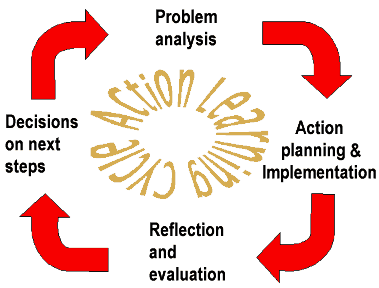
The headline is a virtual motto for the technique of action learning, commonly applied to develop management skills in semi-experienced individuals. The basis of the technique is that individuals work on a project then meet regularly to share progress and learning, but also to subject themselves to intense questioning. There are often casualties too!
The reason for highlighting this is that we have just kicked off an action learning programme for the Head Teachers of our seven schools, all of whom are working on a project to create a five year Vision for their respective schools which is accepted with their staff, their management committee and their communities, and ....... meets the requirements of the government's School Sector Reform Plan! Not too much to ask then!!
We are fortunate to have a friend in Kathmandu, Professor Rajendra Suwal who is facilitating this programme for us and we have high hopes of completing it by December before we embark on the next project ........ values and ethics which in turn continues the development of leadership in our Head Teachers individually and schools generally.

Sunday, 25 July 2010

Schedule for schools development

calendar
Our recent successes in funding and organisation have now placed us in a far better position to plan and schedule the next 8 months or so work in Kathmandu. For example, without the recently awarded grant funding we were a little uncertain as to the scope and nature of next April’s annual Capability Programme. Likewise the volunteering of a number of Cumbrian secondary school teachers now enables us to start planning for some in-school elements to the programme we have not been previously able to consider.
This has also now enabled us to focus more on how best to get added value from our three salaried Nepali Tutors beyond their day to day teaching and occasional running of workshops. There is much planning, organising and background research to be done in Kathmandu that could help us to optimise our efforts and our funding. For example we are still relatively in the dark about the content of the current national teacher training programme in Nepal! Likewise we have found it difficult in short discussions and via email to ascertain what would most benefit the 7 schools in terms of teacher training. Also, how can we stimulate more activity on the British Council’s Global Schools Partnership programme? These are all projects we have allocated to our Tutors and we will be reporting on their findings here in the coming months.
You can view a full outline of our calendar of events in Kathmandu on our main website at http://www.nepalschoolsaid.co.uk/id27.html

Saturday, 17 July 2010

Good news always comes in 3's ……….

What a week this has been, almost everything we have been working for coming to fruition in a way that makes it all worthwhile! Of course all of the items listed below have been worked on for weeks and months in some cases, it’s just that they all were finalised this week.
1. Millom School (Cumbria) Partnership:
The Head Teacher at this Cumbria secondary school has agreed to work with us in a number of different ways including a Global Schools Partnership with Himalaya School, pupils learning about Nepal across their normal curriculum, and …… a supply of teachers volunteering to visit Nepal as part of our annual Teacher Development Programme. So far a total of 7 have volunteered to go in April 2011. Brilliant, and we will be working with them this autumn to slot into our schedule and curriculum.
2. Cambridge University-BackPact Education Project:
This is a group of students from St Catherine’s College, Cambridge who visit a range of countries each year with an aim as follows: “ Simply put, we use theatrical play educationally. We do not intend to teach children ‘about the theatre’, but rather, we are interested in using theatre and performance as a way for young children, many of whom live in difficult circumstances, to build confidence, express their individuality, and have lots of fun.”
We are
arranging for them to spend a week across two of our schools, Bal Bigyan and Bal Vinod in mid August. Exciting stuff and a reward for these two schools who have worked well with us since April to action some of the management training they received in April.


3. Maitri Trust Financial Backing:
We are MORE than pleased to announce that we have been awarded funding by the Maitri Trust to finance the majority of our teacher training programme for the next three years. This will cover expenses of a number of teachers travelling to Nepal each year (but not all), venue costs, material costs etc etc in Kathmandu across a 2 week programme each year.
The Maitri Trust are the charitable foundation of an investment company who want minimal publicity so we are doing our best to respect that here in not revealing too much about them.
So, good news all round from a work and financial standpoint. However we still need the continuing support of our regular donors to maintain the material aspect of our programme such as exercise books, textbooks, school bags. And of course the Maitri Trust have funded about 2/3 of the programme cost, meaning we still need to find another £4000 or so each year.